Iron gall ink
𐑲𐑼𐑯 𐑜𐑷𐑤 𐑦𐑙𐑒
Newton's iron gall ink recipe
Iron gall ink was a popular writing ink from antiquity until the nineteenth century. Unlike the surface-level carbon ink, it burns into the page, as per the Ancient Greek word ἔγκαυστον, suggesting that it may well be the origin of the word "ink".[1]
As its name implies, it's made from iron salts combined with tannic acid from crushed oak galls (or, if you prefer, crushed hawthorn bark), along with gum arabic as a binder.
When you write with iron gall ink, it initially looks dark blue. (This is presumably the reason that dark blue writing ink is still considered professional, while any other hues are not.) Over the next few days, as the iron oxidises, the ink turns black. Over the next few centuries, it turns brown, coincidentally somewhat reminiscent of Sepia ink.
It's relatively easy to make, and text written in it can remain perfectly legible for centuries, making it a popular choice for scribes, artists, and natural philosophers alike.
There are several recipes available. Pseudonymous monk Theophilus mixed his with wine for a longer shelf life. Later, Newton mixed his with strong beer.[2] It seems mould is adverse to alcohol.
Although iron gall ink can last for centuries, it corrodes both metal and eventually paper, so is best used with a quill.[1] You might possibly get away with very hastily cleaning a dip pen after each use, but a fountain pen is right out.
The modern equivalent is archival registrar's ink, as used to record "hatches, matches, and dispatches" (births, weddings, and deaths).
Quotes
To make ink, cut for yourself some wood of the hawthorn — in April or May before they produce blossom or leaves — collect them together in small bundles and allow them to lie in the shade for two, three or four weeks until they are fairly well dried out.
Then have some wooden mallets, and with them pound these thorns on a hard piece of wood until you can completely peel off the bark, which you immediately put in a barrel full of water. When you have filled two, three, four or five barrels with bark and water, allow them to stand like this for eight days until the water has drawn off all the sap of the bark. Then put this water into a very clean pot or into a cauldron, place it on the fire and heat it. From time to time, put some of this bark into the pot so that, if there is any sap left in it, it can be boiled out, and, when you have heated it for a little, take it out and put in some more. This done, boil down what remains of the water to a third [of its original quantity], pour it from this pot into a smaller one and continue to heat it until it becomes black and begins to thicken, taking particular care that you do not add any water except that which was mixed with the sap. When you see it become thick, add a third part of pure wine, put it in two or three new pots and continue to heat it until you see that it develops a kind of skin at the top.
Then lift these pots off the fire and put them in the sun until the black ink resolves itself from the red dregs. Afterwards, take some small, carefully sewn, parchment bags like bladders, pour the pure ink into them and hang them up in the sun until it is completely dried. When it is dried, take from it as much as you want, mix it with wine over a fire, add a little iron vitriol and write. If, as a result of carelessness, the ink is not black enough, take a piece of iron, an inch thick, put it on the fire until it is red hot and then throw it into the ink.
— Theophilus, The Various Arts, date unknown (translated by C. R. Dodwell, 1961)[3]
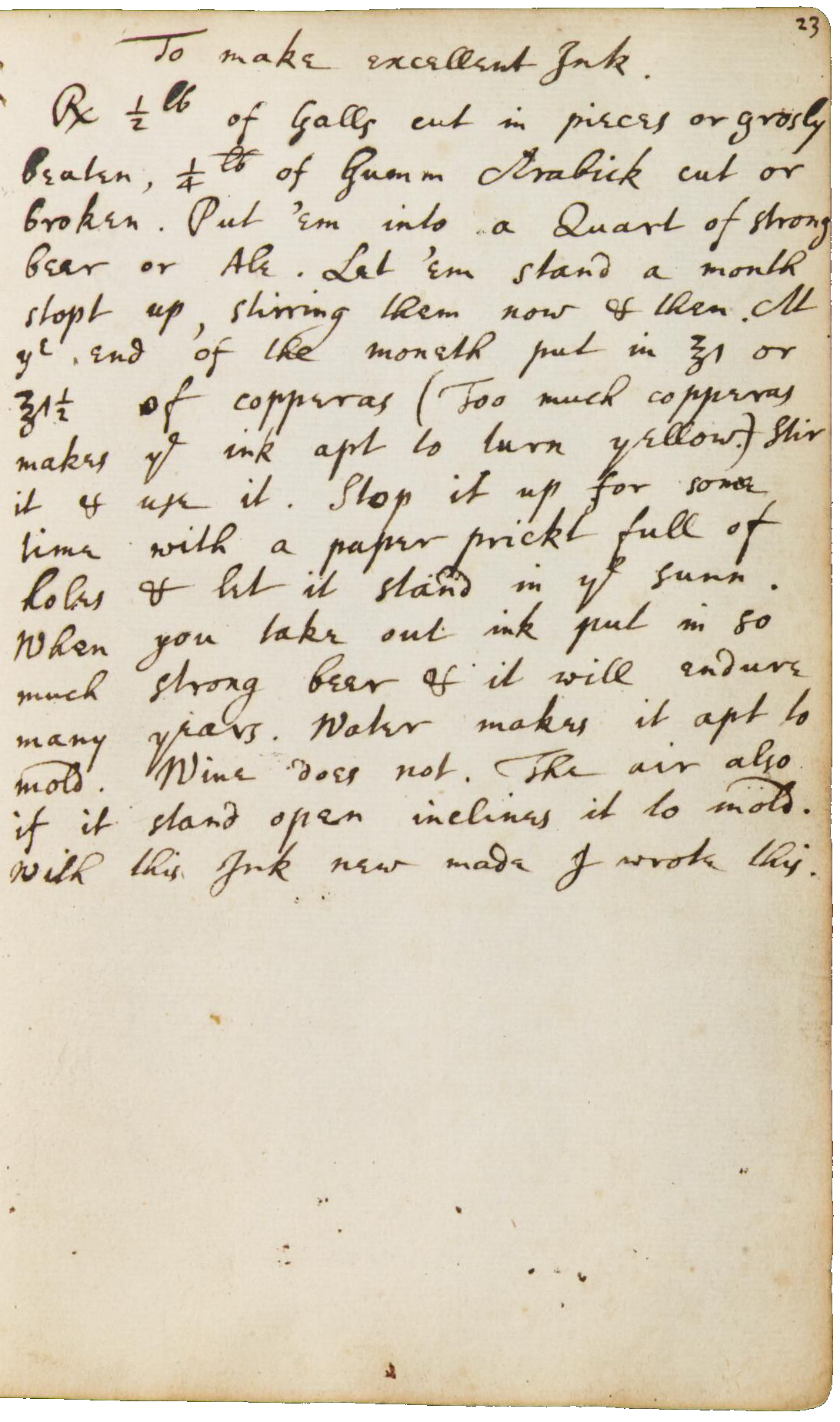
To make excellent Ink.
℞ ½lb of Galls cut in pieces or grosly beaten, ¼℔ of Gumm Arabick cut or broken. Put 'em into a Quart of strong Bear or Ale. Let 'em stand a month stopt up, stirring them now & then. At ye end of the moneth put in ℥1 or ℥1½ of copperas (Too much copperas makes ye ink apt to turn yellow.) Stir it & use it. Stop it up for some time with a paper prickt full of holes & let it stand in ye sunn. When you take out ink put in so much strong beer & it will endure many years. Water makes it apt to mold. Wine does not. The air also if it stand open inclines it to mold. With this Ink new made I wrote this.
— Isaac Newton, circa 1670s[2]
References
- Chapter 5: Writing Fluids Joe Nickell, Pen, Ink, & Evidence, 1990, ISBN 1-58456-017-7, pp. 35—43
- [Untitled laboratory notebook] Isaac Newton, circa 1670s, p. 23
- The Various Arts Theophilus, p. 34
Traditional writing inks: Iron gall ink