
Virtual reality
𐑝𐑻𐑗𐑫𐑩𐑤 𐑮𐑦𐑨𐑤𐑦𐑑𐑦
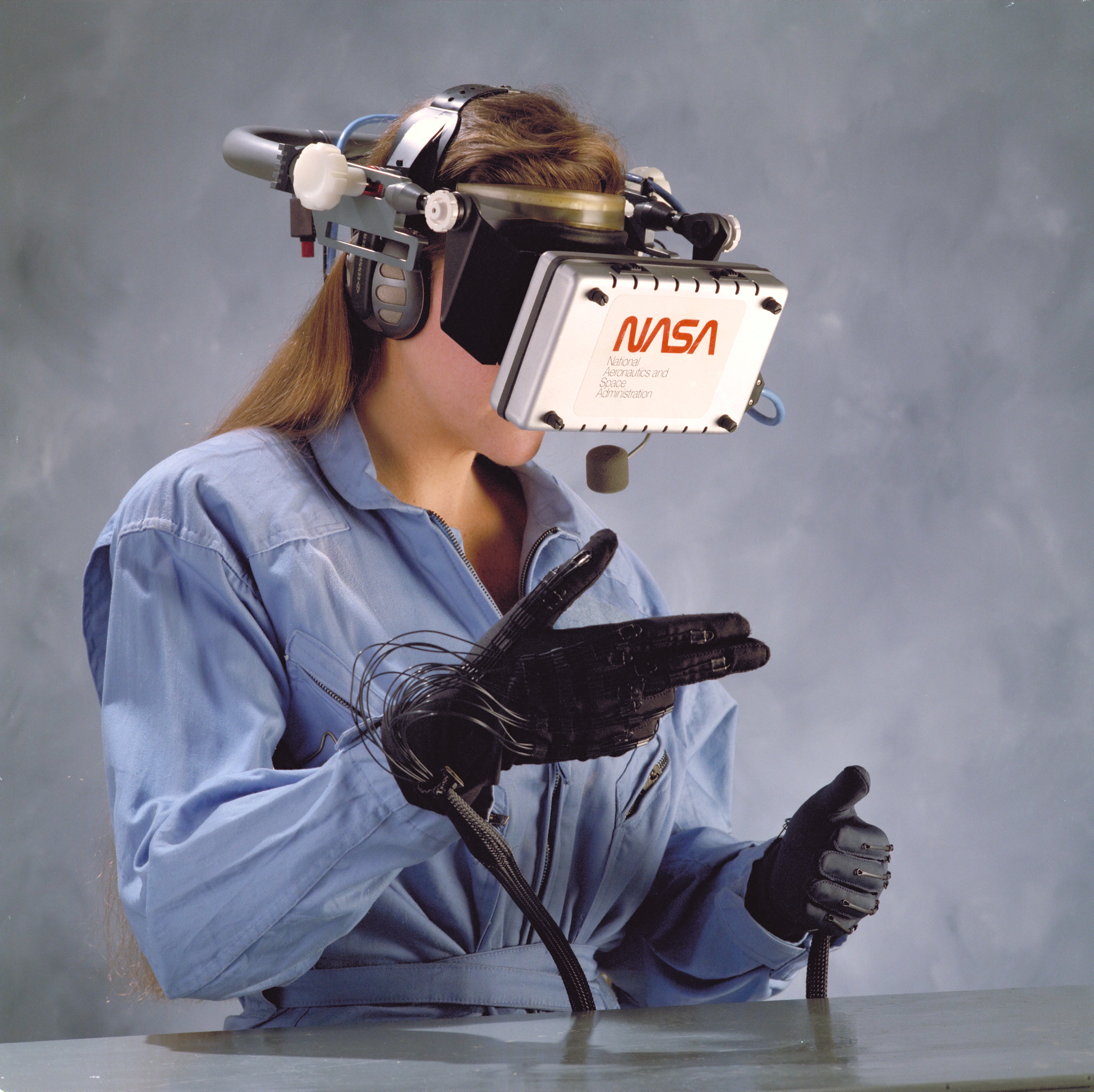
A virtual reality headset
Virtual reality is essentially a technological method of tricking yourself, on some level, into thinking you're inside an imaginary place, rather than that place being inside a screen that in turn exists within the real world.
It involves rendering a 3D environment in realtime, that continually responds to your head movements, compensating for your ever-shifting field of view. This becomes an immersive experience by engulfing several of your senses, chiefly your vision and hearing. With current technology, this is achieved by simply strapping two screens and speakers to your face.
It was briefly popular in the 1990s when short-lived company Virtuality made a virtual reality headset and corresponding games based around a souped-up Amiga, played in arcades where participants were carefully supervised by professionals. I'm just about old enough that I managed to play on some at the London Trocadero when I was a child. Somehow, my neck survived.

Eh, close enough
It then made a brief comeback several decades later, this time for home use. By this point, the technology had significantly improved. The headsets were smaller and lighter, and the resolution and framerate higher, providing a better sense of immersion.
Virtual reality is much like 3D films (which it can also display, in a virtual cinema), in that it seemingly has potential as a very intuitive and engrossing medium, but hasn't yet managed to gain much traction. It probably doesn't help that the headsets are still quite cumbersome, nor that you have to set aside your dignity while wearing one.
Fundamentally, its main issue is that it's pretty solipsistic. For one thing, by overwriting your real vision with a fake one, it effectively removes your vision while tricking you into thinking it's still there, which gives you a tendency to forcefully bump into things with all the unwarranted confidence usually reserved for a mediocre white man explaining something. This makes it best practiced while sitting down, supervised, with everything safely out of arm's reach.
Although it gives its user a fine subjective experience, any onlookers are unable to participate. Contrast with information shown on a screen, which nearby people are free to glance at and discuss with you.
Types of user interface: Virtual reality