Anderssen-Kieseritzky
London, 1851
Anderssen-Kieseritzky London, 1851 (nicknamed the Immortal Game) was a historic friendly chess game played by Adolf Anderssen and Lionel Kieseritzky on 1851-06-21, in between more serious games played at the London 1851 chess tournament.
The game is a good example of the romantic style of play, with Anderssen making a rather bold Queen sacrifice in order to checkmate Kieseritzky... or, at least, he probably would have done, had Kieseritzky not resigned first.

As replicated in Blade Runner
This hypothetical ending of the game, carried out to a checkmate, is fictionalised in Blade Runner as a correspondence game:
22. Qf6+ Nxf6 23. Be7#
Moves
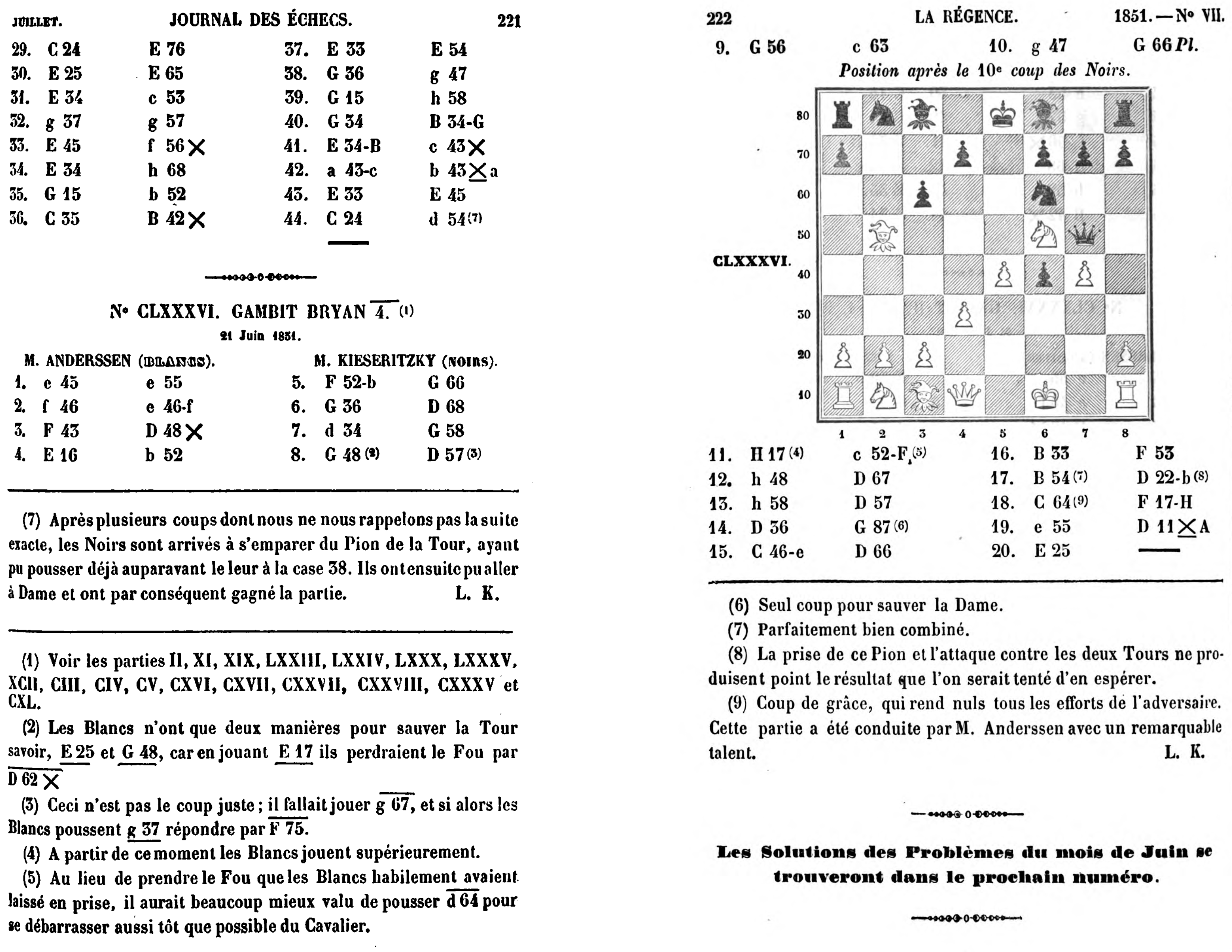
The game was originally published by Kieseritzky in La Régence: Journal des Échecs in 1851, using an early form of algebraic notation in which the pieces' abbreviations are their original files, lowercase for the pawns and uppercase for the pieces proper. When translated into its modern equivalent, the moves are:[1]
1. e4 e5 2. f4 exf4 3. Bc4 Qh4+ 4. Kf1 b5 5. Bxb5 Nf6 6. Nf3 Qh6 7. d3 Nh5 8. Nh4 Qg5 9. Nf5 c6 10. g4 Nf6 11. Rg1 cxb5 12. h4 Qg6 13. h5 Qg5 14. Qf3 Ng8 15. Bxf4 Qf6 16. Nc3 Bc5 17. Nd5 Qxb2 18. Bd6 Bxg1 19. e5 Qxa1+ 20. Ke2
Lasker's later account in Common Sense in Chess swaps Black's eighth and ninth moves, along with much of the ending. He presents the game completed to its conclusion. Translated from descriptive notation, the moves presented there are:[2]
1. e4 e5 2. f4 exf4 3. Bc4 Qh4+ 4. Kf1 b5 5. Bxb5 Nf6 6. Nf3 Qh6 7. d3 Nh5 8. Nh4 c6 9. Nf5 Qg5 10. g4 Nf6 11. Rg1 cxb5 12. h4 Qg6 13. h5 Qg5 14. Qf3 Ng8 15. Bxf4 Qf6 16. Nc3 Bc5 17. Nd5 Qxb2 18. Bd6 Qxa1+ 19. Ke2 Bxg1 20. e5 Na6 21. Nxg7+ Kd8 22. Qf6+ Nxf6 23. Be7#
The version in Tartakower and Du Mont's 500 Master Games of Chess, also in descriptive notation, instead swaps the tenth and eleventh pairs of moves, before affirming Lasker's version of the ending. This gives us:[3]
1. e4 e5 2. f4 exf4 3. Bc4 Qh4+ 4. Kf1 b5 5. Bxb5 Nf6 6. Nf3 Qh6 7. d3 Nh5 8. Nh4 Qg5 9. Nf5 c6 10. Rg1 cxb5 11. g4 Nf6 12. h4 Qg6 13. h5 Qg5 14. Qf3 Ng8 15. Bxf4 Qf6 16. Nc3 Bc5 17. Nd5 Qxb2 18. Bd6 Qxa1+ 19. Ke2 Bxg1 20. e5 Na6 21. Nxg7+ Kd8 22. Qf6+ Nxf6 23. Be7#
This last version includes many more annotations, including several variations.
In the Oxford Companion to Chess,[4] Hooper and Whyld correctly note the game as originally reported at La Régence: Journal des Échecs: 1. e4 e5 2. f4 exf4 3. Bc4 Qh4+ 4. Kf1 b5 5. Bxb5 Nf6 6. Nf3 Qh6 7. d3 Nh5 8. Nh4 Qg5 9. Nf5 c6 10. g4 Nf6 11. Rg1 cxb5 12. h4 Qg6 13. h5 Qg5 14. Qf3 Ng8 15. Bxf4 Qf6 16. Nc3 Bc5 17. Nd5 Qxb2 18. Bd6 Bxg1 19. e5 Qxa1+ 20. Ke2 They then present the widely noted completion as above: 20. ... Na6 21. Nxg7+ Kd8 22. Qf6+ Nxf6 23. Be7#
References
- "No. CLXXXVI. Gambit Bryan 4." Lionel Kieseritzky, La Régence: Journal des Échecs, Jul 1851, pp. 221—222
- Common Sense in Chess Emanuel Lasker, pp. 50—52
- 500 Master Games of Chess Savielly Tartakower, Julius du Mont, 1952, ISBN 0-486-23208-5, pp. 291—293
- The Oxford Companion to Chess David Hooper & Kenneth Whyld, 1984, ISBN 0-19-281986-0, p. 150
Further reading
Encyclopedias
- The Oxford Companion to Chess David Hooper & Kenneth Whyld, 1984, ISBN 0-19-281986-0, p. 150
Chess games: Anderssen-Kieseritzky