
CRT
Not to be confused with critical race theory.
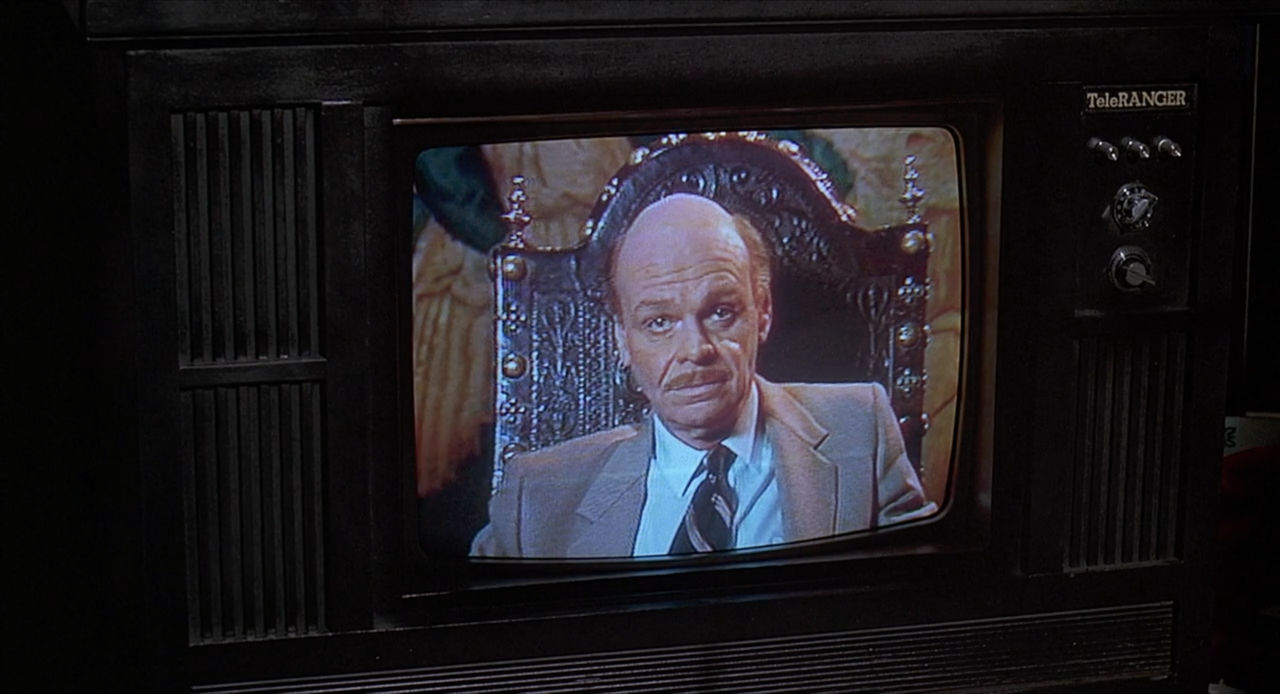
Appearing on a CRT television
A CRT (short for cathode-ray tube) is a type of screen. It was used to make oscilloscopes, TV sets, video terminals, computer monitors, and vector and raster arcade video games, until the affordable flat-panel display made it obsolete at the turn of the twenty-first century.
The tube is made out of glass, and shaped like a cone. It's so empty that it's almost a vacuum, and so it's never comfortably far from the possibility of imploding. The smaller back end has a gun of sorts, that fires a steady stream of electrons at the larger rectangular front end. Electromagnets at the sides methodically and precisely pull these electrons in different directions, forming a 2D image.
The front surface is coated with phosphor, which glows when bombarded with electrons, essentially swapping them out for photons, turning a beam of invisible electricity into a beam of very visible light. This all happens so quickly that the entire image is redrawn several dozen times every second.
It's great that display technology evolved. It's for good reason that flat-panel displays became more popular than CRTs once they became affordable. They're thinner, lighter, use less power, and are now higher resolution.
However, as with all obsolete media, although it was at one point as close as you could get to a perfect representation of something, it's now revered by some people precisely because it fails at perfect representation. Now that you no longer have to put up with CRTs, because they're no longer the state of the art, you can better appreciate the aesthetics of their charming flaws.
Tips
Remember how I said earlier that electromagnets direct the beam? Don't put speakers or any other kind of magnets next to a CRT monitor. They'll warp the image. This doesn't seem to do any permanent damage, but still, it isn't ideal.
Conversely, don't put cassette tapes or floppy disks near monitors or speakers, as they could wipe their data.
When filming a CRT, you'll need to adjust your camera's shutter angle to avoid showing screen flicker. For example, when filming my Atari ST's SM124 monitor in the UK, filming it at 24 FPS, I've found that a shutter angle of 121° or 242° works best.
When making a film in which someone uses a CRT (or any other kind of display), the screen will light the actor's face as a blurry, unfocused light. If you want to project the mirror image of what's on the CRT onto the actor's face, you'll need to cheat and use a projector... or have them wear glasses, preferably sunglasses.
See also
Further reading
Deep dives
- "What a Wonder Is a Terrible Monitor" Jason Scott, ASCII, Dec 2012
- "Simulating CRT Monitors with FFmpeg (Pt. 1: Color CRTs)" VileR, int10h.org, Jan 2021
- "Simulating CRT Monitors with FFmpeg (Pt. 2: Monochrome CRTs)" VileR, int10h.org, Feb 2021
Analogue aesthetics: CRT | Cassette tape | Orchestron
CRT displays: Oscilloscope | Raster display | Vector display